
Life After Death: Beginning Again After Narcissistic Abuse
Trauma Is a Death. This Is What Comes After.

I’ve died more times than I can count, and yet somehow, I’m still sitting here breathing.
Okay, maybe not literal death, but the kind that begins with a sudden, gut-wrenching shock.
We don’t depict words as weapons the way we depict knives, but they cut just as deep. One sentence can split your nervous system open. One accusation can feel like a blade. One distortion of reality can leave you bleeding in places no one can see.
It may start with shock, but after comes the panic.
I don’t know if that’s an accurate enough description, because it’s not just panic. It’s all-consuming, drowning, screeching, shrill panic. The kind where nothing exists outside of it. Your thoughts scream at you to breathe, but you can’t, because your body doesn’t believe it’s safe enough to inhale. The world narrows to a single point of threat.
Eventually, something shifts, not because you’re okay, but because your body can’t sustain that level of alarm forever. And when it drops, it doesn’t drop into relief. It drops into collapse.
The kind where you could fall to the floor wailing and wondering how you’re supposed to go on.
But you don’t.
Because sometimes things just fuckin’ blow and you’ve still got responsibilities to attend to and a life to attempt to live.
So you stand up.
You put on the mask with the perfect the smile and answer emails. You make dinner. You show up and function while actively bleeding on the inside.
And no one can tell, because “all things considered,” you seem pretty fine.
When this happens repeatedly, something inside you learns to minimize it. You start pretending it isn’t happening because you don’t have the luxury of falling apart every time your nervous system is split open.
But then you’re left alone at night, scared, lonely, and desperately wishing someone could see it. And when you realize no one can see it, not even you sometimes, another part of you dies again.
For me, the realization doesn’t happen immediately.
I’m a high-functioner by both breeding and nature. I literally don’t know what it’s like to not push through, because I grew up hearing shit like, “Put your shoulder to the wheel.” That’s also the lyrics to a hymn, and it’s currently living rent-free in my head, and I hate it, so in protest, I’m loudly singing the lyrics to baby got back in my head, but it’s not working. The hymn is too deeply buried in there. Regardless, much like my pioneer heritage and the Energizer Bunny, I just keep going.

The death shows up months later when I’m already practically a zombie again, but no one notices, aside from the fact that I’m just quieter than normal. It’s hard for me to spot, even.
In the numbness.
In the disconnection.
In looking back and realizing how much of myself I lost without even noticing it at the time.
That’s when it hits with a wave of gut-wrenching grief. It’s the kind of sadness that makes your chest ache with the kind of wailing cries we see depicted by Banshees in movies, but no one else can feel it.
I am not the same person, and I don’t know how to get her back, but I somehow have to keep living and put all my missing pieces back together again. That feels like a big ask.
Some of the deaths were sudden, explosive ruptures that changed everything overnight. Some were quieter, like shedding a skin I didn’t realize I had outgrown until it split open.
But narcissistic abuse has its own particular kind of death.
Because it doesn’t just wound you, it destabilizes and destroys your reality.
It looks like:
Apologizing before anyone accuses you.
Taking responsibility for someone else’s bad mood.
Assuming every inconvenience is your fault.
Replaying conversations at 3 a.m. trying to find the moment you “misstepped.”
Not trusting that good things will stay.
Not trusting your memory.
Not trusting your perception.
It’s blaming yourself before your abuser has the chance to, and living in constant anticipation of accusation.
And over time, the fog rolls in.
The fog is heavy and oppressive. It muffles the voices of the people who love you while it amplifies the voice of your pain. It feels dark, like you’re reaching for a light that moves just a little farther away every time you stretch toward it, and cold, like you’ve forgotten what warmth is supposed to feel like.
You can understand intellectually what happened.
But your nervous system doesn’t operate on logic.
Every day, before I make a decision, I check:
Who is driving right now? Is it me? Or is it my nervous system, still scanning for threat? Because hypervigilance doesn’t disappear just because the relationship did.
You didn’t just leave a relationship.
You survived a neurological event, and I am not going to sit here and pretend like you aren’t in pain. I actually will very loudly refuse to ignore the fact that, honey, you have internal bleeding and we should do something about that.
I will sit next to you in it.
I will hold your hand.
And when you’re ready, not before, we will stand up together and walk out of the fog. You don’t have to do this alone.
You Survived a Neurological Event
When I say you survived a neurological event, I’m not being poetic. I’m being literal.
Chronic gaslighting changes the brain.
When someone repeatedly denies your memory, reframes your reactions as the problem, withholds affection when you question them, and then returns with tenderness just when you’re about to detach, your nervous system does what it was designed to do: it adapts.
Not because you’re dramatic. Not because you’re unstable. Because your brain is wired to detect social threat.
Human attachment is not optional. We are biologically programmed to maintain connection. When connection becomes unpredictable, your nervous system reads that unpredictability as danger. And when danger is perceived, even subtly, the amygdala activates. Cortisol rises. Adrenaline surges. Your heart rate shifts. Your digestion changes. Your muscles tighten without you consciously choosing it.
At the same time, the prefrontal cortex, the part of your brain responsible for logic, reasoning, and perspective, becomes less accessible. This is why you couldn’t “just calm down.” This is why you found yourself replaying conversations in the shower, analyzing tone at 3 a.m., or apologizing before anyone had accused you of anything. Your body was attempting to prevent the next rupture.
It was scanning for micro-signals in a relationship that had no consistent rules. You were trying to solve a puzzle that kept changing shape.
Over time, this does more than create stress. It creates conditioning.
The Addiction No One Explains Properly
There’s another layer that makes narcissistic abuse especially destabilizing, and it’s rarely discussed in a grounded way.
Intermittent reinforcement.
When affection is steady, the brain adapts. It normalizes safety. Predictability becomes baseline.
But when affection is unpredictable, when warmth follows cruelty, when intimacy follows dismissal, when praise follows punishment, dopamine spikes more intensely. Uncertainty increases reward response. The brain learns to associate relief with heightened payoff.
You begin chasing relief without realizing that’s what you’re doing.
This isn’t a weakness or moral failure. It damn sure isn’t proof that you’re addicted to drama.
It’s chemistry.
When the relationship ends, your body doesn’t just grieve the person. It grieves the cycle. The spike. The crash. The brief reconciliation. The illusion of safety that followed chaos.
Even if you never missed them, you may have missed the structure. Because chaos, however painful, is still a pattern. And patterns can feel stabilizing when you’ve been living inside them long enough.
Why the Fog Stays
Understanding something is not the same as feeling safe.
You can read about gaslighting and call it narcissistic abuse. You can explain trauma bonding to your best friend with frightening accuracy.
And still find yourself:
Overthinking a neutral text, or flinching at a raised voice that isn’t even directed at you.
Apologizing automatically when someone looks irritated, and second-guessing a decision you already made.
Intellectual clarity does not immediately restore nervous system safety.
If your body spent years bracing for emotional impact, it doesn’t simply unclench because the relationship ended. If you learned that love comes with instability, your system may interpret calm as suspicious. If you learned that speaking up led to punishment, certainty can feel risky.
The fog isn’t a weakness.
It’s a transition.
It’s what happens when your body is trying to figure out which world it’s living in now.
You might notice:
You’re hyper-aware in environments that are objectively calm.
You’re exhausted even when nothing dramatic is happening.
You feel strangely numb during moments that should feel happy.
You brace when someone is kind, waiting for the turn.
Sometimes it shows up physically. Headaches that won’t explain themselves. Nausea before difficult conversations. Shaking hands over small decisions. Going very quiet in a room without meaning to.
And then you criticize yourself for it and tell yourself you should be over it, but this isn’t regression.
It’s a nervous system coming down from chronic activation, and coming down doesn’t look graceful. It looks like recalibration.
It looks like your body is slowly learning that not every raised eyebrow means abandonment. Not every pause means punishment. Not every silence means danger.
You’re not crazy.
You’re untangling.
You’re detoxing from distortion.
So What Do We Do With That?
We start by refusing to minimize it. We don’t shame it. We don’t bypass it. We don’t pretend you’re fine just because you’re functioning. We acknowledge that something real happened. That something real changed you. That some version of you did not survive this intact.
And instead of scrambling to resurrect her exactly as she was, we allow ourselves to sit in the aftermath long enough to feel solid ground again.
You are not behind. You are not weak. You are not dramatic.
You adapted to survive instability.
Now your body has to learn what stability feels like.
That takes patience.
I am not going to rush you. I am not going to tell you to “just move on.” Instead, I’ll sit in the fog with you, and when you feel steady enough, we’llstand up and take a step forward.
Together.
A Ritual for Naming What Changed
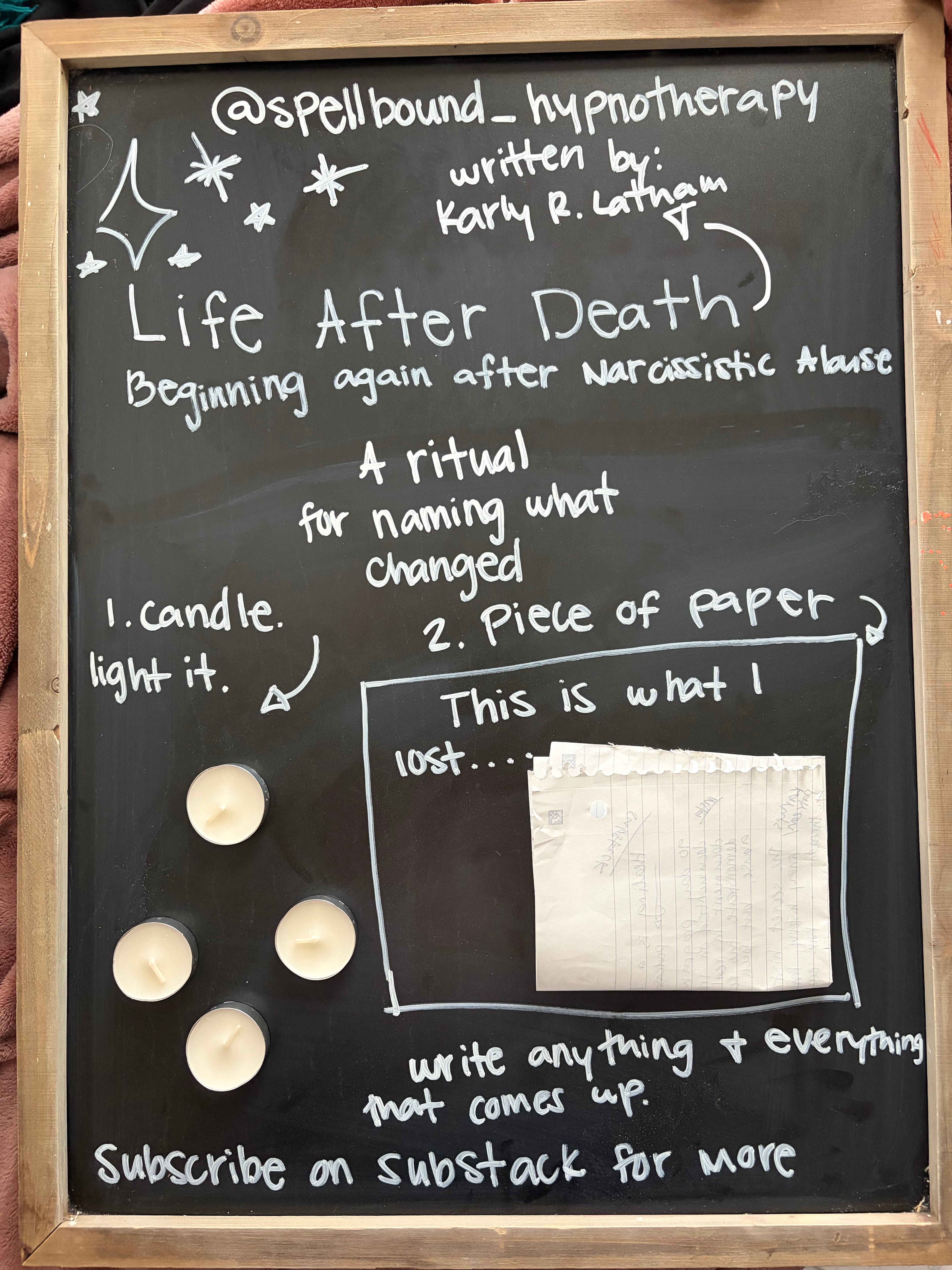
Before you try to fix anything, rebuild anything, or redefine yourself, it helps to acknowledge that something ended.
Not in a dramatic way. Not in a way that turns you into a tragic heroine. Just in a clear, steady way.
Set aside a few quiet minutes. Light a candle, not because you need anything mystical to happen, but because a small, steady flame gives the nervous system something consistent to focus on. Stability matters right now.
Take a piece of paper and write the sentence:
This is what I lost.
Be honest. You don’t need to justify what you write. You don’t need to minimize it or explain why it “wasn’t that bad.”
Maybe you lost certainty.
Maybe you lost trust in your memory.
Maybe you lost ease in your body.
Maybe you lost sexual confidence, spiritual innocence, or the version of yourself who spoke without bracing.
Write whatever comes up.
Read it back slowly. Notice what happens in your body as you do. You may feel sadness. You may feel anger. You may feel nothing at all. All of those responses are valid.
When you’re ready, blow out the candle.
Not as a symbolic grand ending, but as an acknowledgment. Something changed. Something ended. And you are allowed to mark that without rushing past it.
Fold the paper and put it somewhere private. You are not trying to resurrect that exact version of yourself. You are simply honoring that she existed, and that she mattered.
Acknowledgment is stabilizing. Denial is not.
A Tarot Reflection: After the Death
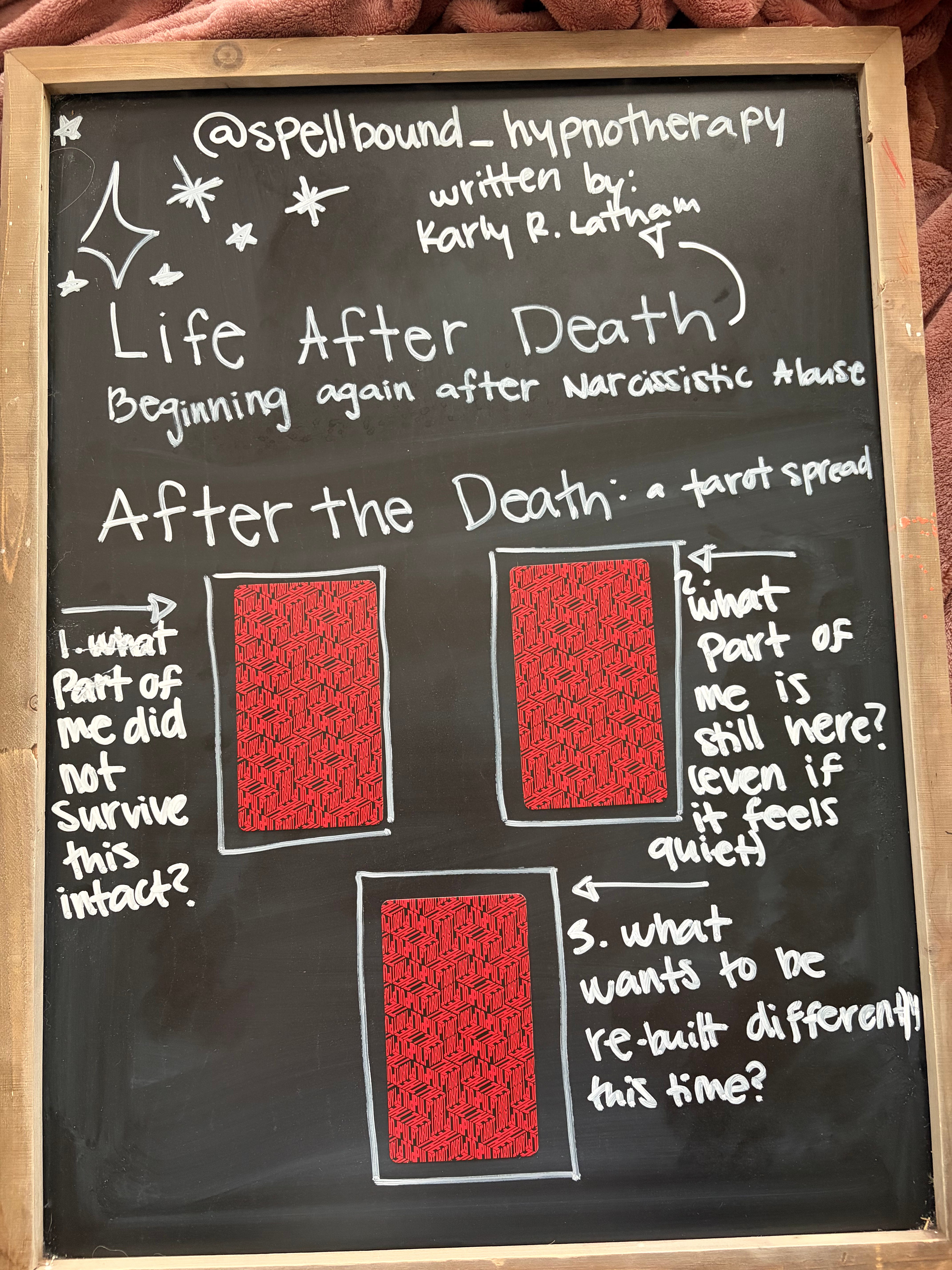
If you work with tarot, you can use it here as a structured reflection tool. This isn’t about prediction. It’s about perception.
Pull three cards, slowly and intentionally.
What part of me did not survive this intact?
What part of me is still here, even if it feels quiet?
What wants to be rebuilt differently this time?
When you look at the cards, resist the urge to interpret them immediately. Instead, notice your first bodily reaction. Do you tense? Do you feel relief? Resistance? Recognition?
The nervous system often responds before the intellect does.
After that initial response, journal briefly about each card. A few sentences are enough. This is not a test of how well you read tarot. It’s a structured way of listening to yourself.
If you’d like a simple grounding phrase as you shuffle, you can say:
“Show me what I’m ready to see.”
Not because the cards control your fate, but because intention helps focus attention.
The goal here is not to create a dramatic turning point. It’s to create steadiness. Reflection, when done gently, helps restore trust in your own perception, and that is one of the first things gaslighting erodes.